LLM Price Comparison 2026: Ranked by Cost per Quality
A data-driven 2026 LLM price comparison across GPT-5.5, GPT-5.6 Sol, Claude Sonnet 5, Claude Opus 4.8, Gemini 3.5 Pro, Llama 4 Scout, DeepSeek V4 Pro and Mistral Large — with cost-per-quality rankings and when to pick each one.
Refreshed July 14, 2026 with the current frontier lineup pulled live from our pricing API. The frontier-model landscape in mid-2026 looks nothing like it did 12 months ago. Open-weight models are within a few points of the top-tier reasoning models on most evals, prompt caching is universal, and the blended-cost spread between the cheapest and most expensive frontier model is now ~61×. If you're still routing every request to a flagship, you're almost certainly overpaying.
This guide is the head-to-head LLM price comparison we wish existed: real 2026 list prices, a blended cost number that reflects how teams actually use these models, and a cost-per-quality ranking so you can pick the right tier for each workload. All numbers below come straight from our own live pricing API, cross-checked against provider pricing pages and the Artificial Analysis leaderboard.
The 2026 frontier pricing table
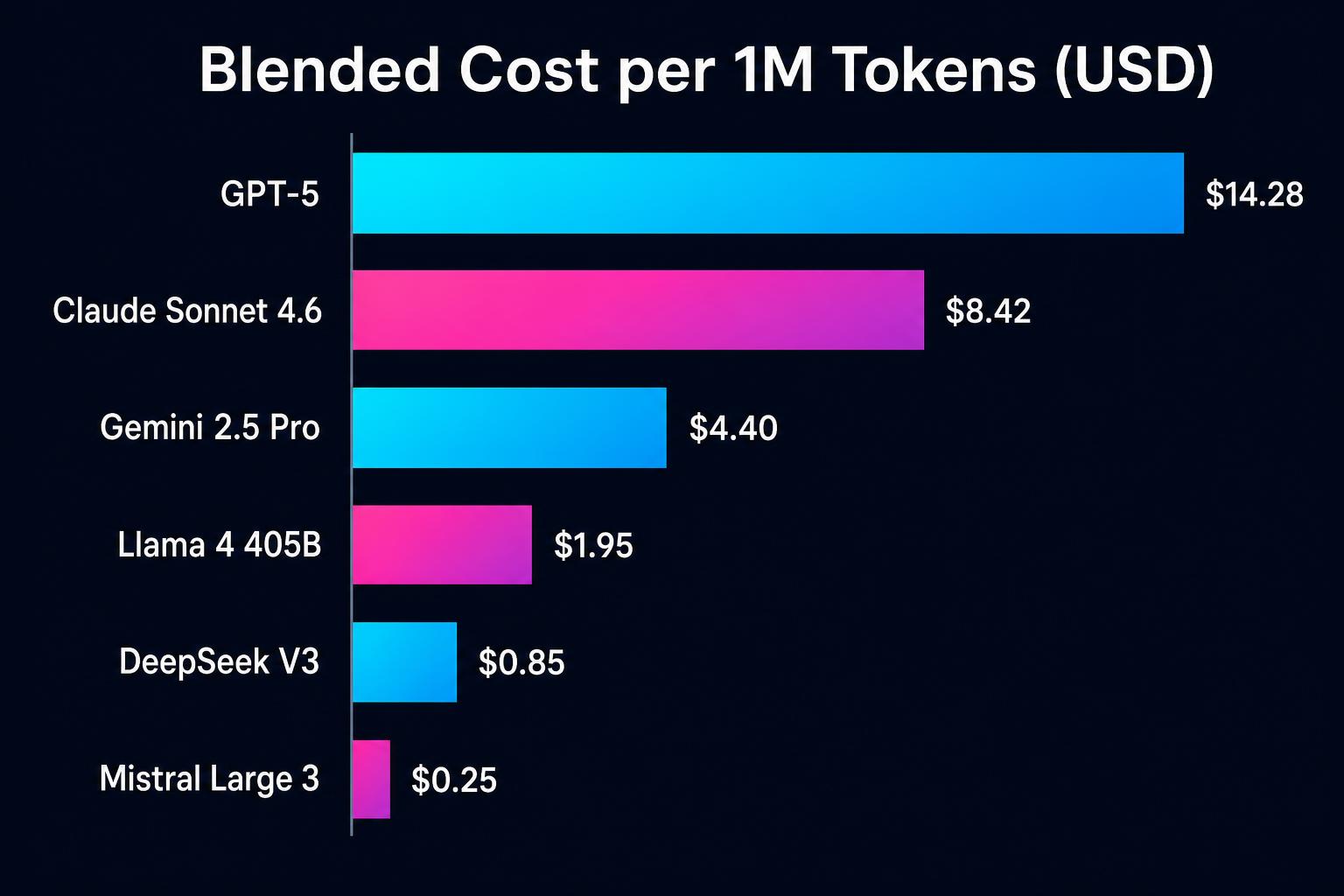
Prices are USD per 1M tokens, list rate, no volume or cache discounts. "Blended" uses a 70% input / 30% output weighting, which matches typical chat and RAG workloads.
| Model | Input | Output | Blended (70/30) | Context |
|---|---|---|---|---|
| GPT-5.5 (high) | $1.25 | $10.00 | $3.88 | 922K |
| GPT-5.6 Sol (preview) | $2.00 | $16.00 | $6.20 | 1M |
| Claude Sonnet 5 | $3.00 | $15.00 | $6.60 | 1M |
| Claude Opus 4.8 | $5.00 | $25.00 | $11.00 | 1M |
| Gemini 3.5 Pro | $1.50 | $12.00 | $4.65 | 2M |
| Llama 4 Scout 17B | $0.11 | $0.34 | $0.18 | 10M |
| DeepSeek V4 Pro (max) | $0.27 | $1.10 | $0.52 | 1M |
| Mistral Large | $2.00 | $6.00 | $3.20 | 128K |
Source: llmcalculator.net live pricing API (/api/v1/models), refreshed July 14, 2026. Cross-checked via our model comparison tool.
Cost per quality: the only ranking that matters
Raw token price is misleading. A $0.20 model that fails 40% of your evals is more expensive than a $6 model that works first try. Using the Artificial Analysis Quality Index alongside blended cost, here's how the current frontier lineup ranks on cost-adjusted quality — best value first.
- Llama 4 Scout 17B — $0.18 blended. The runaway winner on raw cost, with 10M context for long-document work.
- DeepSeek V4 Pro (max) — $0.52 blended. Best cost-per-quality for reasoning-heavy workloads inside the sub-$1 tier, alongside Grok 4.3 ($0.66 blended) — see the full Grok pricing guide.
- Mistral Large — $3.20 blended. EU-hosted option that's competitive on European-language and code tasks.
- GPT-5.5 (high) — $3.88 blended. The default frontier workhorse — top-tier quality at less than a third of Opus.
- Gemini 3.5 Pro — $4.65 blended. The best long-context deal on the frontier tier, especially past 500K tokens.
- GPT-5.6 Sol (preview) — $6.20 blended. Preview pricing; strong on agentic loops but priced against Sonnet 5.
- Claude Sonnet 5 — $6.60 blended. Best-in-class tool use and coding; the agent-loop default.
- Claude Opus 4.8 — $11.00 blended. Highest quality on hard reasoning, use sparingly behind a router.
What real workloads cost in 2026
Talking in $/M tokens is abstract. Here's what 1,000 typical interactions cost on each model, using the same workload profiles as the rest of the site:
| Workload | GPT-5.5 | Sonnet 5 | Gemini 3.5 Pro | DeepSeek V4 Pro |
|---|---|---|---|---|
| Chat (1.5K in / 400 out) | $5.88 | $10.50 | $7.05 | $0.85 |
| RAG (8K in / 600 out) | $16.00 | $33.00 | $19.20 | $2.82 |
| Agent loop (12K in / 2K out) | $35.00 | $66.00 | $42.00 | $5.44 |
Plug your own token counts into the cost calculator if your usage profile differs.
Which model should you pick?
Pick GPT-5.5 (high) when
You want the current best default frontier workhorse. At $1.25/$10 per 1M it undercuts Sonnet 5 on both sides of the ledger and holds up on most reasoning evals — the sensible baseline before you consider anything more expensive.
Pick Claude Opus 4.8 when
You're shipping a high-stakes feature where a couple of quality points move business metrics — legal drafting, medical summarization, complex code generation. The $25/M output rate hurts; use it sparingly behind a cascading router.
Pick Claude Sonnet 5 when
You're building agents that call tools, write code, or hold a 500K+ token conversation. Claude's tool-use reliability and prompt caching (90% off cached input) are still best-in-class.
Pick Gemini 3.5 Pro when
You need to process huge documents (>200K tokens) or video. The 2M context window plus aggressive long-context pricing make it the only sane choice for full-codebase or full-book inputs.
Pick Llama 4 Scout 17B when
You have data-residency or model-portability requirements, or you need a genuinely cheap long-context tier. Open weights plus 10M context let you serve it on Fireworks, Together, or your own cluster.
Pick DeepSeek V4 Pro when
Cost is the #1 constraint and your evals tolerate a few quality points of headroom vs the top tier. Ideal for classification, extraction, summarization, and the cheap tier of a cascading router.
Pick Mistral Large when
You're in the EU and want first-party European hosting, or you need the absolute cheapest viable frontier model for high-volume background jobs.
The three pricing levers that change the math
1. Prompt caching (50–90% off)
Every major provider now offers prompt caching. If your system prompt is 4K tokens and 1,000 users share it, caching collapses your effective input cost by an order of magnitude. Always design prompts with the static portion first.
2. Batch API (50% off)
For non-realtime work — evals, backfills, classification jobs — batch APIs cut the bill in half with a 24-hour SLA. Underused by most teams.
3. Model cascading
Send 80% of requests to DeepSeek V4 Pro or Gemini 3.5 Flash. Escalate to GPT-5.5, Sonnet 5, or Opus 4.8 only when the cheap model returns low confidence. Real-world savings: 60–75% with negligible quality loss.
The bottom line
In 2026, picking an LLM is a portfolio decision, not a single choice. Use DeepSeek V4 Pro or Llama 4 Scout as your default. Reserve Claude Sonnet 5 for agents. Reserve Claude Opus 4.8 for the 5% of requests that genuinely move metrics. Run the numbers for your own traffic in the cost calculator, then sanity-check the quality side on the comparison page.
By the LLMCalculator.net Research Team · Last updated: July 14, 2026
Related reading: This week in LLM pricing (weekly snapshot) · How to cut your LLM bill by 60% · GPT-4o vs Claude Sonnet · Find the cheapest LLM for your workload.